
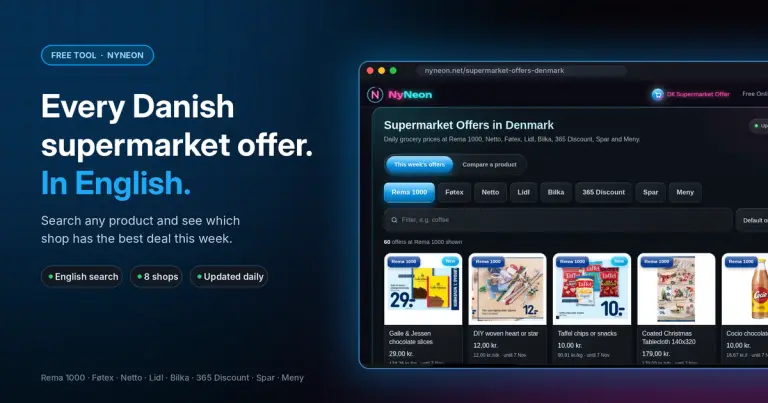
Danish supermarkets run big weekly offers, but the flyers are in Danish and spread over eight chains. Here’s a free tool that shows every offer in English.
If you live in Denmark, you’ve probably noticed that every supermarket has its own offers. Netto has one price on eggs this week, Lidl has another, and Rema 1000 might have them cheapest of all. The same goes for meat, coffee, milk and washing powder. The offers change every week, and they’re different in every shop.
That’s useful if you know where to look. It’s hard work if you don’t, especially when every flyer and app is in Danish. That’s the reason we built the Supermarket Offers Denmark tool on NyNeon, and this post is about why it exists and how to get the most out of it.
Denmark is an expensive place to fill a fridge
This isn’t just a feeling. When Eurostat compared price levels across the EU for 2024, Denmark came out as the most expensive country overall, about 43% above the EU average. Food in particular has been a sore spot for years. In Eurostat’s 2015 survey, a basket of food and soft drinks in Denmark cost 145% of the EU average, the highest in the union. Later surveys have shuffled the exact ranking a bit, but Denmark keeps landing near the top.
There’s some good news in 2026. Statistics Denmark’s numbers show food prices actually falling: in September 2026 they were 2.1% lower than a year earlier. That helps. But “a bit cheaper than last year” in an expensive country is still expensive. If you’re a student living on a tight budget, or working shifts and sending money home, every week’s shop matters.
The offers are where the real money is
Here’s the thing most newcomers miss. In Denmark, the normal shelf price is only half the story. The other half is the tilbud, the weekly offer.
Every chain prints a weekly flyer, the tilbudsavis, and it’s packed. When the Danish Cancer Society counted offers in 2024, they went through 48 flyers from eight nationwide grocery chains and found 5,063 food offers, plus another 854 on alcohol. That’s thousands of discounted products every few weeks, and Danes take it seriously. Some chains say well over a million people read their flyer each week.
And some of these discounts are big. Not “save 2 kroner” big. Meat, coffee, butter, nappies, washing powder: things you’d buy anyway can drop to a price that makes the normal one look silly. Shops use these deep cuts to pull you through the door, hoping you’ll buy the rest of your list at full price while you’re there. It works. Even prices across the whole country move with it. A chief economist at Danish Industry pointed out that food prices jump every January simply because the Christmas offers on meat and butter end and prices go back to normal.
So the smart move is simple: know what’s on offer, and where, before you leave the house. If you buy your weekly basics when they’re on tilbud, and skip them when they aren’t, you can save real money without eating any differently.
The problem: eight shops, eight flyers, one language
Knowing the offers sounds easy. In practice it’s a chore.
First, there are a lot of chains. Rema 1000, Netto, Lidl, Føtex, Bilka, 365discount, Spar, Meny. Each has its own flyer, its own app, its own week. To compare them properly you’d have to flip through all of them, every week.
Second, and this is the big one if you’re not Danish: everything is in Danish. The flyers, the apps, the existing offer sites. Product names like skrabeæg, letmælk, kyllingebryst, rugbrød or vaskemiddel mean nothing until you’ve learned them, and the abbreviations on price tags are even worse. You end up translating word by word, guessing, and giving up halfway through.
That’s a real barrier, and a lot of people face it. Denmark admitted 2,065 international students to English-taught programmes this year alone, on top of everyone already here studying or working. Plenty of us can get by in Danish at the checkout. Reading a thick flyer fast enough to compare prices is a different skill.
What the tool does
I wanted one page that answers two questions in seconds: what’s on offer right now? and where is the thing I need cheapest?
See every offer, with the shop name on it
Open the page and you’ll see current offers from eight chains in one place: Rema 1000, Føtex, Netto, Lidl, Bilka, 365discount, Spar and Meny. Each offer card shows the product, the price and which shop it’s in. No more opening eight apps. Scroll once, and you know where this week’s good deals are.
Search for what you actually need
Most of the time you don’t want to browse. You want eggs. Or chicken. Or toilet paper. Type the product into the search box and the tool shows you which shops have it and at what price, so you can see straight away where the best deal is.
That turns grocery planning into a two-minute job. Check your list, search each item, decide which shop (or two) to visit. Done. You save the money, but you also save the time you’d spend walking between shops or reading flyers.
Search in English, get results in English
This is the part I care about most. You don’t need to know that eggs are æg or that minced beef is hakket oksekød. Search “egg”, search “minced beef”, search “butter”, and you’ll get results back in English.
For international students, new arrivals and anyone still learning Danish, that removes the biggest obstacle completely. You can shop like a local in your first week instead of your second year.
Fresh every day
Prices are updated every night, so when you check in the morning before work or before class, you’re looking at today’s offers, not last week’s.
A few honest caveats
The tool is free and it’s useful, but I don’t want to oversell it.
Offers can sell out. A deal on the page doesn’t promise the shelf will still be full at 6 pm on a Friday. Some offers also only apply with a membership app, a minimum quantity (“3 for 50 kr”) or at certain stores, so read the details on the shop’s side if a deal looks unusually good.
The English translations are there to help you find things, and they cover everyday groceries well. Very specific brand products or unusual items may still turn up with Danish names now and then. If you spot one, tell me (the contact details are below) and I’ll fix it.
And the big one: an offer is only a saving if you were going to buy the thing anyway. The Danish Cancer Society’s count found that 46% of flyer offers were for soft drinks, sweets, snacks, alcohol and ready meals. Cheap crisps are still crisps. Use the offers for your actual list, not as a reason to add things to it.
How I’d use it, week to week
If you want a simple routine:
Write your shopping list for the week. Before you go, open the tool and search each staple: milk, eggs, bread, rice, chicken, coffee, whatever you go through. Note which shop is cheapest for the expensive items, because that’s where most of the saving is; a few kroner on a loaf of bread matters less than a big cut on meat or detergent. Then glance through the full offer list once for anything you were going to need soon anyway. Stock up on long-lasting things when they’re properly cheap. It’s also an easy way to build the three-day food supply Europe recommends.
That’s it. No coupons, no spreadsheets, no Danish dictionary.
Key takeaways
- Denmark has some of the highest consumer prices in the EU, so offers make a real difference to your grocery bill.
- Danish chains run thousands of weekly offers, and some discounts are very large.
- The Supermarket Offers Denmark tool shows offers from Rema 1000, Føtex, Netto, Lidl, Bilka, 365discount, Spar and Meny in one place, with the shop name on every card.
- You can search for a product and see where it’s cheapest, which saves both money and time.
- Search works in English and results come back in English, so you don’t need to read Danish to find a good deal.
Try it this week
Next time you’re writing a shopping list, open the tool before you leave the house and search three things you buy every week. See which shop wins. I’d genuinely like to know whether the result surprises you.
If something’s missing, a translation looks wrong, or you want another shop added, send a message to [email protected]. The tool is built for people who find Danish grocery shopping confusing, so feedback from you is the most useful thing I get.
Sources
- Eurostat, Comparative price levels of consumer goods and services (2024 data, published December 2025): https://ec.europa.eu/eurostat/statistics-explained/index.php/Comparative_price_levels_of_consumer_goods_and_services
- Eurostat 2015 food price survey, reported by the National Statistical Institute of Bulgaria: https://www.nsi.bg/en/statistical-data/106/351
- Trading Economics, Denmark Inflation Rises to 1-Year High (Statistics Denmark data, October 2026): https://tradingeconomics.com/denmark/inflation-cpi/news/591072
- Danish Cancer Society count of supermarket flyers, summarised by Nordic Alcohol Policy (August 2025): https://www.nordicalcohol.org/post/almost-every-second-product-in-supermarket-flyers-is-unhealthy
- North Media, growth in minetilbud and leaflet readership (2022): https://www.northmedia.dk/en/3-kvartal-2022-den-digitale-platform-minetilbud-omsaetter-for-22-mere/
- Danish Offshore Industry, food prices and Christmas offers, comment by DI chief economist Allan Sørensen: https://www.doi.dk/en/havenergi/artikel/saenket-elafgift-faar-inflationen-til-at-dykke
- Study in Denmark, More than 2000 international students admitted (July 2026): https://studyindenmark.dk/news/more-than-2000-international-students-admitted-studying-in-denmark