
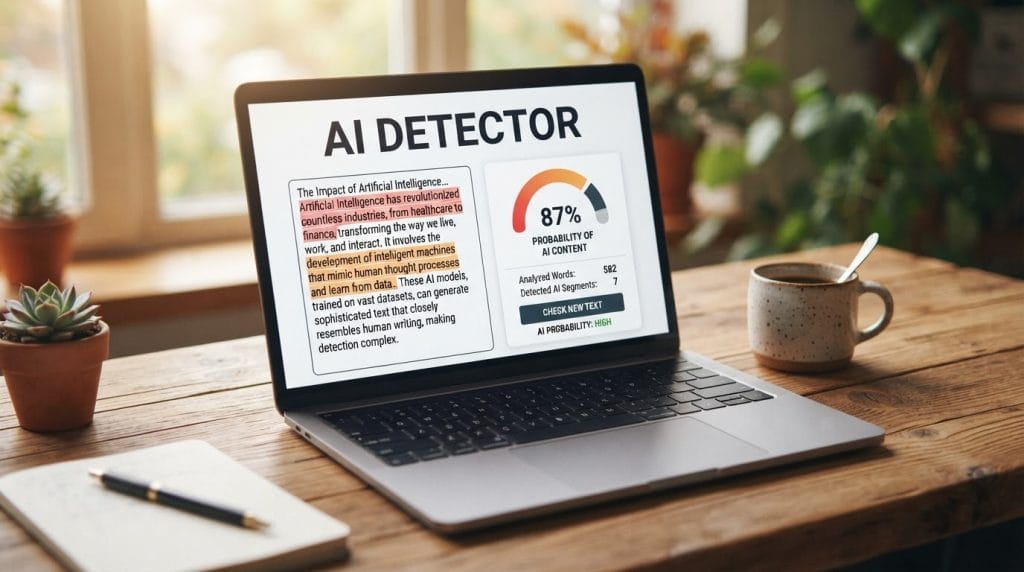
Search for a free AI detector with no word limit and you’ll get plenty of results, including NyNeon’s own free AI text detector, which has no word limit and needs no account. Most of the others have a catch, and the word limit is the smaller one. The bigger one is that the score you get back is a statistical guess, and sometimes it’s a bad guess.
We went through the main free AI detectors, checked what each one lets you scan, and read the independent tests instead of the vendors’ own marketing. The short version: the well-known tools all cap you somewhere, the ones that don’t cap you are mostly small and unproven, and no tool gives you a result you should treat as proof. Our own detector is still in beta, so that last point applies to it too.
What each free plan really gives you
Free limits change a lot, and review sites disagree with each other. The numbers below come from vendor pages and reviews checked between June and November 2026. Where sources conflict, I say so.
| Tool | Free limit | Account needed? | Paid plans |
|---|---|---|---|
| GPTZero | 10,000 words a month. Per-scan cap is 5,000 to 10,000 characters depending on the source | Free account for larger scans | Around $13 a month billed yearly |
| Copyleaks | 25,000 characters per scan, plus a small monthly credit allowance | Not for a single scan | Roughly $8 to $14 a month, sources differ |
| ZeroGPT | 15,000 characters per check | No | About $8 to $10 a month |
| QuillBot | 1,200 words per scan, 6 scans a day | No | Premium removes the cap |
| Scribbr | 1,200 words per check, unlimited checks | No | AI score also comes inside a plagiarism report, from $19.95 a document |
| Sapling | 2,000 characters per query | No | $25 a month |
| Pangram | About 2,000 words a day by most accounts, though others report fewer checks | Yes | $20 a month, 7-day trial |
| Originality.ai | No real free tier. Sources conflict | n/a | $14.95 a month |
| Grammarly | Free detector, no limit stated on its page | Page doesn’t say clearly | Extra detector features need Pro |
Pangram is a good example of the fog. Its own pricing page doesn’t describe a free plan at all, only a 7-day trial. The free allowance shows up in third-party reviews, and they don’t agree.
ZeroGPT is the closest thing to unlimited among the known names. No account, no daily limit that I could find, and 15,000 characters per check is roughly 2,300 words. One competitor’s review puts its monthly allowance at 1.25 million words, which is effectively no limit for most people. But keep reading, because ZeroGPT is also the tool that does worst in the tests below.
Why nobody gives away unlimited scanning
Part of it is cost. Sapling publishes its API price: $0.005 per 1,000 characters at the lowest volume tier. A 2,000-word blog post is about 12,000 characters, so one scan costs around six cents. Tiny for one person. Not tiny if a million people paste in essays every month and pay nothing.
The other part is business. This is my reading, not something a vendor told me, but the free tier looks like advertising for the paid one. One industry directory describes GPTZero’s free plan in exactly those terms: it brings in users, and the monthly cap pushes heavy users toward a subscription.
A few small sites do advertise no limit and no sign-up, like GPTInf and HumanizeAI.pro. A third one, MyDetector, takes up to 200,000 characters but has a daily quota, so it isn’t really unlimited either. I couldn’t find independent accuracy tests for these. The accuracy numbers I did find come from the sites themselves. One of them, aicheckr.io, claims 95%+ in its own comparison table against competitors. That’s a company grading itself. Some of these sites, aicheckr.io for one, also offer an AI humanizer, a tool that rewrites text so it passes detectors. Make of that what you want.
There’s also privacy. When you paste your thesis or a client’s draft into a free site, you’re sending it to a company you know nothing about. Vanderbilt listed unclear data policies as one of its reasons for switching off Turnitin’s detector. GPTZero says it keeps a copy of submitted text but doesn’t share it with third parties.
If you really want free and unlimited, there’s one honest route. Open-source detectors like Fast-DetectGPT and Binoculars run on your own machine with no quota. The catch is that they need serious GPU hardware, and they have the same accuracy problems as everything else.
What the tools actually measure
Most detectors run your text through a language model and measure two things. Perplexity is how predictable each word is. Burstiness is how much your sentence length and structure vary. AI text tends to be smooth and predictable. Human text tends to be messier.
The trouble is that careful, formal, well-edited writing also scores as predictable and even. Which brings us to the Declaration of Independence.
In October 2024, Christopher Penn, a data scientist at Trust Insights, pasted the preamble into a detector and it came back 97.75% AI-generated. The detector was ZeroGPT. Decrypt reran the test and got 97.93%. In the same test QuillBot called the text 100% human, and GPTZero gave an 89% probability of human authorship. Penn’s explanation is that the repeated phrasing in the document looks like machine repetition to the detector. I can’t verify that explanation, but the result itself is easy to reproduce.
A text written in 1776 got flagged by the free tool with the loosest limits. That’s worth remembering when you see “98.4% accuracy” on ZeroGPT’s homepage, next to a claimed false positive rate under 1%.
How accurate are they, really?
Vendors say 98 or 99 percent. Copyleaks claims over 99% with a 0.03% false positive rate. GPTZero says 99.9%. Independent tests are messier, and they don’t all point the same way.
A study posted to arXiv in August 2026 by Karr, Khvatskii, Hua and Chawla tested commercial detectors on published research abstracts. They used a threshold of 0.50 and proxy labels for human and AI, so treat the exact numbers with some care. Unedited human abstracts from 2023 to 2025 were flagged 9% to 15% of the time, and non-STEM abstracts were flagged far more often than STEM ones. Abstracts that had only been lightly edited by AI for wording got flagged 38% to 80% of the time. The scores followed long words and dense academic vocabulary, which says something about the writing style being measured and little about who wrote it.
On the other side, Epoch AI tested Pangram, GPTZero and Originality.ai on human and AI passages. Pangram and GPTZero flagged none of 495 human passages. Originality.ai flagged 19, or 3.8%, and all 19 were writing that predates ChatGPT. For AI text from a plain prompt, the detectors missed 0.7% at most. But when the AI imitated a specific author’s style, they missed about 13%, and about 26% for scientific writing.
So the best paid tools can be very good on clean test sets. The problems show up at the edges: edited text, imitated style, short text, formal writing, and non-native English. Those happen to be exactly the cases people care about in real life.
For the record, OpenAI tried this too. It launched its own AI text classifier in early 2023 and shut it down on July 20, 2023, citing low accuracy. By its own numbers it correctly caught 26% of AI-written text and wrongly flagged 9% of human text.
Who gets hurt by false positives
The best-known study is from Stanford, by Liang and colleagues, published in the journal Patterns in 2023. They ran seven detectors on 91 essays written by non-native English speakers for the TOEFL exam, and on 88 essays by US eighth graders. The eighth-grade essays were handled almost perfectly. The TOEFL essays were flagged as AI about 61% of the time on average. All seven detectors flagged 18 of the 91 essays, and at least one detector flagged 89 of them.
That study is from 2023 and vendors say they’ve responded. GPTZero says it trains to keep the false positive rate for this kind of writing at 1%. I haven’t found an independent re-test that settles it either way, so I’d call it an open question.
Then there’s simple arithmetic about base rates. Say 10,000 essays come in and 5% were written by AI. That’s 9,500 human essays and 500 AI ones. A detector with a 1% false positive rate flags 95 innocent essays. If it catches 90% of the AI ones, that’s 450 correct flags. Out of 545 flags, 95 are wrong, about one in six. A 1% error rate sounds small until it’s your essay in the one in six.
Vanderbilt did a version of this math in August 2023. Turnitin claimed a 1% false positive rate, and Vanderbilt had submitted 75,000 papers in 2022, so around 750 could have been flagged wrongly. It switched the detector off, along with concerns about bias against non-native speakers and a lack of transparency about how the tool works. Oregon State followed in September 2023, and Curtin University in Australia turned the feature off from January 2026.
Turnitin’s own numbers show why this is slippery. It says its document-level false positive rate is under 1% for documents with at least 20% AI writing, and around 4% at the sentence level. Those are different measurements, and a highlighted sentence isn’t evidence.
A New York case shows what it looks like when it goes wrong. In January 2026, a state judge in Nassau County ordered Adelphi University to reverse sanctions against student Orion Newby, whose essay Turnitin had scored 100% AI. Two other detectors, Grammarly and ZeroGPT, called it human. Be careful about what the ruling means, though. The court called the finding without valid basis, but the decision was about a flawed hearing process, not a scientific verdict on detectors. It isn’t binding precedent, and at least one other student case went the school’s way.
The humanizer problem, and watermarks
If detectors guess wrong on honest writing, what about people who actively try to evade them? In the same Karr study, after AI-labeled texts were rewritten with a humanizer tool (Undetectable AI), fewer than 4% were still flagged. The authors pointed out an ugly consequence: someone who uses AI honestly for light editing can face more risk than someone who uses a humanizer on purpose.
Detector vendors dispute the general picture. Originality.ai says it ranked first on humanized text in two third-party benchmarks, though that claim is on its own site. It’s an arms race, and any result is a snapshot of one week.
Watermarking is the other idea. Google open-sourced SynthID Text, which hides a statistical pattern in the words a model picks. In theory a detector can then check for that pattern. A July 2026 preprint from Tamim and Khan tested it and found that paraphrasing removed the watermark in 58 of 59 texts where it had been detected. Before any attack, the detection already missed about 80% of watermarked text in their setup. It’s a preprint and a small test of one implementation, so don’t over-read it. But it shows the problem isn’t solved. And a watermark only exists if the company that built the model put it there.
What about Google and SEO?
If you run a blog, you might be wondering whether you need to run your posts through a detector to rank. Google’s own guidance on AI content says it cares about quality however a page is produced, and that using AI mainly to manipulate rankings breaks its spam rules. I didn’t find Google saying that you have to pass a detector. Some SEO vendors say so, but that’s their claim, not Google’s.
So for a blog, the useful question is whether the post helps the person reading it. A detector score doesn’t answer that.
How to use a detector without getting burned
Treat the score as a reason to look closer, not a verdict. Even vendors describe their results as probabilities.
Use enough text. Pangram won’t score anything under 50 words, and short samples are unreliable across the board. If you’re checking a long document, scan the whole thing first and then the suspicious sections, since a passage can get a different score on its own than inside the full text.
Two detectors disagreeing tells you something. Two detectors agreeing doesn’t prove much, because in the Stanford study all seven agreed on 18 essays that were human-written.
If you’re the writer and you’re worried about being accused, keep your drafts and version history. Several of the reviews I read recommend exactly this, and it settles most cases faster than arguing about a percentage. Grammarly also has an Authorship extension for Chrome that lets you show which parts of a document were human-written, AI-generated or AI-edited.
And don’t paste anything confidential into a free site you know nothing about.
Where NyNeon’s own detector fits
NyNeon has its own free AI text detector, so it’s worth being clear about what it is. It has no word, character or daily limit, and it needs no account. It runs in your browser, so your text isn’t uploaded to a server. The first time you use it, it downloads a detection model of about 67 MB, which your browser then keeps. It combines a small AI model’s score with checks on sentence-length variation, vocabulary variety and overused AI phrases.
It’s still in beta, and I wouldn’t claim more for it than for the others. Everything above applies to it too: short text, heavily edited text, polished formal writing and non-native English can all give wrong results. Paste at least 15 words, more is better, and treat the number as a hint.
Key Takeaways
- No major AI detector is free with unlimited text. Free tiers cap per scan, per day or per month: GPTZero at 10,000 words a month, Copyleaks at 25,000 characters per scan, ZeroGPT at 15,000 characters, Sapling at 2,000.
- Small sites that advertise “unlimited” usually have no independent accuracy data, and some sell humanizers alongside.
- Vendors claim 98% to 99% accuracy. Independent tests find 9% to 15% of unedited human abstracts flagged and 38% to 80% of lightly AI-edited ones, though the best tools score well on clean test sets.
- Non-native English writers get flagged more. A 2023 Stanford study found a 61% average false positive rate on TOEFL essays.
- Humanizers and paraphrasing beat most detectors, and text watermarks aren’t reliable yet.
- NyNeon’s own free AI text detector has no limits and runs in your browser, but it’s in beta and the same accuracy warnings apply.
- A score isn’t proof. Use it to start a conversation, and keep drafts if you’re the one being checked.
If a detector has ever flagged something you wrote yourself, or you want to know more about how our own detector works, email us at [email protected].